Lower Blepharoplasty Beverly Hills | Dr. Christopher Zoumalan
You feel fine. The mirror disagrees, and so do the people who keep telling you that you look tired. Under-eye bags do not answer to sleep or concealer, because the cause sits under the skin rather than on it. Lower blepharoplasty repositions the fat casting the shadow instead of stripping it out.
Dr. Christopher Zoumalan holds board certification in ophthalmology and fellowship training through ASOPRS, with over 20 years of clinical experience and more than 9,000 procedures on eyelids alone. Much of that work has been repairing lower lids hollowed elsewhere, which taught him how little to take.
Find out in one unhurried appointment whether lower eyelid surgery suits your eyes.
Request Your Consultation or call 310.278.4000
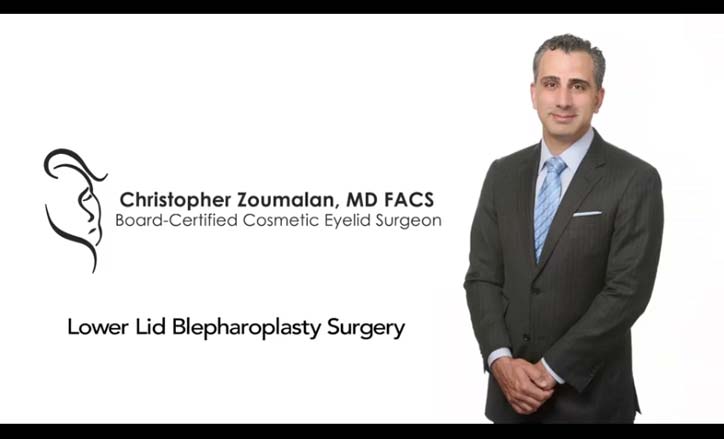
What Is Lower Blepharoplasty?
Lower blepharoplasty, also called a lower eyelid lift, is a cosmetic eyelid surgery that restores a smooth transition across the lid cheek junction. Under-eye aging happens in three places at once: the orbitomalar ligament holds skin to the infraorbital rim while the tissue around it descends, the orbital septum weakens and lets orbital fat push forward, and skin elasticity falls as collagen and elastin break down.
During eye bag surgery Dr. Zoumalan repositions the fat pads instead of removing them, then tightens skin only where it is genuinely lax.
Lower eyelid blepharoplasty addresses:
- Under-eye bags, puffiness, and herniated fat pockets
- Dark circles and hollowness along the tear trough deformity
- Fine lines, wrinkles, and sagging skin beneath the eyes
- A tired appearance that rest does not improve
Ideal candidates for under eye surgery are typically between 235 and 70, though genetics bring some patients in far earlier with inherited lower eyelid bags. The goal of lower lid surgery is a brighter under-eye area with no change to the shape of your eye, no visible scar, and a youthful appearance in facial harmony with the rest of your face.
Lower blepharoplasty, or lower eyelid surgery, is a form of cosmetic eyelid surgery that rejuvenates the under-eye area by correcting puffiness, excess skin, and dark circles. The procedure removes or repositions fat and tightens the skin around the eyes to create smoother, firmer contours. Dr. Zoumalan, a specialist in oculoplastic surgery, often uses the transconjunctival technique, which leaves no visible external scars. This refined approach produces natural, rested results while maintaining each patient’s unique expression and eye shape.
Why Choose Dr. Zoumalan for Lower Eyelid Surgery?
Choosing the right surgeon matters more here than in almost any other cosmetic procedure, because the lower lid is unforgiving of overcorrection. A general plastic surgeon operates across the whole body; an oculoplastic surgeon works only on the eyelid and orbit.
- Exclusive Specialization: Dr. Zoumalan focuses exclusively on cosmetic eyelid and periorbital procedures. Lower blepharoplasty is not one of many operations he performs. It is his area of complete expertise.
- Credentials & Subspecialty Training: Board-certified by the American Board of Ophthalmology and fellowship-trained through the American Society of Ophthalmic Plastic and Reconstructive Surgery. ASOPRS fellowship is the most prestigious subspecialty training in the field. Review his full credentials.
- Extensive Experience: Over 20 years of clinical experience and more than 9,000 procedures, including revision eyelid surgery and lower lid retraction repair for patients left with scleral show after another surgeon’s lower eyelid surgery.
- Natural Results Philosophy: He works to a “less is more” standard, creating subtle changes that refresh your appearance without looking operated on. The before and after photos are the honest test of it.
- Academic Excellence: operating at the Quad A accredited Innovate Surgery Center he co-founded.
Individual results may vary. Outcomes depend on age, skin quality, healing, and adherence to post-operative instructions.
The Lower Blepharoplasty Process
Consultation
Every case begins with a free virtual assessment: you send photos, Dr. Zoumalan reviews them, and only candidates are booked in, so nobody travels for an appointment that was never going to happen. The in-office consultation runs about an hour, during which he will:
- Assess eyelid laxity with a snap back test and check for a negative vector eye
- Look for festoons and malar mounds, which lower blepharoplasty cannot correct
- Review your medical history and medications, including blood thinners
- Explain which surgical technique matches your anatomy, and why
- Answer your questions without rushing you toward a decision
Our Patient Care Coordinator then provides a written quote. You leave with an individualized treatment plan and a realistic understanding of recovery time.
Procedure Details
Lower blepharoplasty is performed at our accredited Beverly Hills surgical center and takes approximately two hours.
- Anesthesia: Local anesthesia with IV sedation in most cases, with general anesthesia available.
- Technique: Dr. Zoumalan generally uses a transconjunctival blepharoplasty approach, a hidden incision inside the eyelid behind the capsulopalpebral fascia, so no external scar forms and the orbicularis muscle stays intact. Transcutaneous blepharoplasty cuts through skin and muscle at the lower lash line and carries a higher risk of the lid pulling down, so external incisions are reserved for genuine excess skin.
- During surgery: He releases the arcus marginalis and drapes the herniated fat over the infraorbital rim rather than excising it, a maneuver related to the septal reset. Where skin is lax he adds a skin pinch blepharoplasty, laser resurfacing, radiofrequency microneedling, or a chemical peel for skin tightening. A canthopexy or canthoplasty supports the lateral canthus when lid tone requires it.
Fat repositioning is the core of his Natural Looking Blepharoplasty® technique, and it is what prevents the hollowed look that fat removal alone produces over time.
Recovery
- Days 1 to 3: Swelling and bruising peak. Cold compresses and a head elevated on two pillows minimize discomfort, and most patients describe mild soreness rather than pain.
- Week 1: Sutures, if any were placed, typically come out around day five to seven. Swelling and bruising begin to subside.
- Weeks 2 to 4: Most patients return to work and social activities around day ten to fourteen. Light exercise resumes as tolerated; strenuous activity waits for clearance.
- Months 1 to 3: Final results appear as the last swelling resolves and the lid-cheek junction settles.
- Long term: Results are long-lasting, and most patients enjoy a refreshed appearance for a decade or longer. Repositioned fat rarely returns as a bulge. Aging continues, and sun exposure affects how the area holds up.
See which lower eyelid technique fits your anatomy before you commit to anything.
Ideal Candidates for Lower Lid Blepharoplasty
- Age and health: Most patients are between 25 and 70, though age alone does not determine candidacy. Good overall health, realistic expectations, and non-smoking status matter more.
- Specific concerns: Persistent under-eye bags or puffiness, dark circles and hollowing that rest does not improve, loose skin and wrinkles beneath the eyes, or an interest in under eye bag removal after fillers have stopped being enough.
- Medical considerations: Uncontrolled dry eye or untreated medical conditions generally rule out surgery for now. Dr. Zoumalan evaluates lid tone and midface projection to determine whether lower eyelid blepharoplasty is appropriate, and where hollowing rather than fat is the real problem he will recommend tear trough treatment with dermal fillers instead.
A consultation with Dr. Zoumalan is required to determine whether you are a candidate for this procedure and to discuss outcomes specific to your case.
Combining Lower Blepharoplasty with Other Treatments
Many patients pair lower blepharoplasty with complementary procedures to achieve broader rejuvenation. These additions smooth the skin around the eyes, improve facial harmony, and extend the refreshed effect created by eyelid surgery.
Upper Blepharoplasty
Upper blepharoplasty removes excess skin and refines sagging tissue of the upper eyelids. Combined with lower blepharoplasty, both lids are treated to one standard in a single operation: contours refined, puffiness reduced, and the eyes brightened without the two halves looking as though they were addressed years apart.
Quad Blepharoplasty
Quad blepharoplasty addresses all four eyelids in a single session. For patients who already know they want upper eyelid surgery as well, it means one anesthetic, one recovery, and one period away from work rather than two. Dr. Zoumalan will say at consultation whether the combined approach suits your anatomy.
Brow Lift
A brow lift elevates low brows and eases forehead heaviness so the eyes appear more open. An eyelid lift cannot correct a brow that has descended onto the upper lid, and lifting the brow often reduces how much upper eyelid skin needs to come off at all. Each lift is tailored to individual anatomy.
Tear Trough Filler
Where hollowing rather than herniated fat is the real problem, dermal fillers along the tear trough restore volume without surgery. Dr. Zoumalan uses this as a first step for younger patients, and as a refinement after lower eyelid blepharoplasty when a shadow remains.
Lower Blepharoplasty Cost and Financing in Beverly Hills
Cost depends on the technique required, the anesthesia, facility fees, and whether upper eyelid surgery is done at the same time. Dr. Zoumalan prices each case individually, and our Patient Care Coordinator provides a written quote before you commit. Financing options through PatientFi include zero-interest plans. Insurance does not cover cosmetic lower eyelid surgery.
Schedule Your Lower Lid Blepharoplasty Consultation in Beverly Hills
Eyelid surgery is a subspecialty, and the difference between a rested result and an operated one usually comes down to how conservative the surgeon is willing to be. Dr. Zoumalan has built over 20 years of clinical experience on that restraint. Every case starts with a free virtual photo review, so non-candidates find out before spending time and money coming in.
Book the appointment that tells you what lower blepharoplasty can realistically do for your eyes.

Frequently Asked Questions About Lower Eyelid Blepharoplasty
How much does lower blepharoplasty cost in Beverly Hills?
Cost depends on the complexity of your case and the technique used, so Dr. Zoumalan prices each patient individually. Our Patient Care Coordinator provides a quote before your consultation. Financing through PatientFi includes zero-interest plans and flexible monthly payments.
How long do swelling and bruising last after lower blepharoplasty?
Swelling and bruising typically peak in the first three days and fade over seven to ten days. Discomfort is generally mild and managed with over-the-counter medication. Most patients return to work around day ten to fourteen and resume normal activity within three weeks.
Does lower blepharoplasty remove wrinkles under the eyes?
Lower blepharoplasty softens wrinkles caused by loose skin and herniated fat, but fine lines from sun damage usually need laser resurfacing or a chemical peel alongside surgery. Dr. Zoumalan will tell you at your consultation which of your lines are surgical and which are not.
Will lower eyelid surgery leave a visible scar?
In most cases, no. Transconjunctival blepharoplasty places the incision inside the lower eyelid, so there is no external scar and no sutures on the skin. When a small skin excision is required, the incision sits just beneath the lash line and typically heals to near invisibility.
How long do results last once under-eye aging continues?
Most patients enjoy a smoother lower lid for a decade or longer, and repositioned fat rarely returns as a bulge. Aging does not stop, so the surrounding face continues to change and sun exposure affects how the area holds up. Individual results vary.
What are the risks of lower blepharoplasty?
As with any surgical procedure, lower blepharoplasty carries potential risks including swelling, bruising, infection, dry eye, asymmetry, and eyelid retraction. Serious complications are uncommon when the procedure is performed by a qualified oculoplastic surgeon. Dr. Zoumalan discusses all potential risks during your consultation.